Palermo: The City That Once Rivalled Constantinople
Ask most people to name the great cities of twelfth-century Europe, and Palermo rarely comes up. Paris, Rome, Milan, perhaps Naples. And yet in the year 1100, only a handful of European cities were larger: Constantinople, Thessaloniki, Seville, Cordoba. The history of Palermo is a fascinating one…
This is the first in a series of posts tracing how that happened, the story of a city that has been founded, besieged, conquered and rebuilt so many times over the last two and a half thousand years that almost nothing survives from before the eleventh century. It’s one of the stops on our small-group cultural tour of Sicily, and it may be the most layered place on the whole itinerary.
A city built for a harbour
Palermo’s origins go back to the 8th century BC, when Phoenician traders and seafarers, already established at Carthage, founded a colony here, one of three in western Sicily, alongside Mozia and Solunto. They named it Ziz, meaning flower.
The choice of site was no accident. Look at a large-scale map and the logic is obvious: mountains close in the city to the south and west, and it faces out to the Tyrrhenian Sea to the east. Two rivers, the Papireto to the north and the Kemonia to the south, enclosed the settlement and fed its harbour, still recognisable today as Palermo’s yacht marina. A defensive wall once ran around the whole city; a few fragments survive in the foundations of the Norman Palace, and Via Gioeni still traces the old course of the Papireto. Even with the wall itself long gone, that ancient outline is still stamped into the modern street plan.
The Greeks called the settlement Panormos, “complete port”, and it’s from this, by way of the Arabic Balarm, that we eventually get Palermo.
A thousand years of the early history of Palermo, yet almost nothing left
The Romans took the city in 254 BC and, by all accounts, made it a flourishing one; a fragment of Roman Palermo survives in the Piazza Bonanno, on the Corso between the Norman Palace and the Cathedral. Vandals sacked it in 445 AD, Ostrogoths held it after that, and in 535 AD the Byzantine general Belisarius retook it for Justinian. Byzantine rule then continued, with that one interruption, for close to a thousand years.
And yet almost nothing built in all that time remains today, not the walls, not the churches, hardly a stone. For a city that held out for a year-long siege when the Arabs finally took it in 831, a siege that only makes sense against a substantial defensive wall, that’s a striking absence. Palermo is, in this sense, an unusual case among the great cities of Italy.
The Arab capital of Sicily
It was the Arabs who made Palermo the administrative capital of the island, a title that had previously belonged to Siracusa. Under the Aghlabid dynasty, and later the Fatimids and the Kalbids, the city was renamed Balarm, and the old walled centre became known as the Kasr, the palace, a name that survives today in the Cassaro, the main street running through the city’s heart.
Why Palermo, and not somewhere closer to the Arab conquerors’ North African homeland, such as Mazara or Trapani? The likeliest answer comes back to that original piece of topography: a sheltered harbour, and mountains that supplied plentiful fresh water, the resource that would go on to define the city’s golden age.
By the twelfth century, the Arab geographer Ibn Jubair described a capital “endowed with two gifts, splendour and wealth,” its streets wide, its buildings recalling Cordoba, “a permanent stream of water from four springs” running through it, and so many mosques, many doubling as schools, that he gave up trying to count them. A new suburb, Al-Khalisa, grew up just outside the old walls; it survives today as the Kalsa district. The population of the city at its height is estimated at somewhere between 60,000 and 120,000, a genuinely major city by the standards of the age.
Water, wheat and the introduction of citrus
Palermo’s wealth rested on its position at the centre of the Mediterranean, roughly midway between Constantinople and the Iberian peninsula, north Africa and northern Italy, at a time when trade still moved mostly by sea rather than overland. Its principal export was durum wheat, alongside nuts, timber, oil, cheese, furs, hides, hemp and cloth.
What the Arab centuries introduced to the island reads like a modern greengrocer’s shelf: citrus fruits, aubergines, pistachios, apricots, rice, carob, pomegranates, sugar cane, spinach, chickpeas, artichokes. Alongside them came paper and ink, legal reform, and, most consequentially of all, water management. The qanats, underground aqueducts built using a technique developed in Persia, still carried water into the city as late as the middle of the last century. Three have been rediscovered to date, mostly in the upper part of the city beyond the catacombs, and a few can still be visited.
The population living alongside this trade and engineering was itself remarkably mixed: Arabic-speaking Muslims, Greek- and Latin-speaking Byzantine Christians, and a significant Jewish community, all practising their own faiths under Arab rule on payment of a per-head tax, the jizya, levied on non-Muslim subjects in return for protection and the right to worship freely. The tax outlasted the Arabs themselves: even after the Norman conquest, Sicily’s remaining Muslim minority went on paying it, locally known as the gisia.
The Normans, and a chapel like nowhere else in Italy
That multicultural city passed to new rulers in January 1072, when the Norman brothers Robert Guiscard and Roger, after a four-month siege, took control of Palermo. It was Roger’s son, Roger II, who in 1132 commissioned the Palatine Chapel inside the old Arab palace at the western end of the city, on the site of what is now the Sicilian regional parliament.
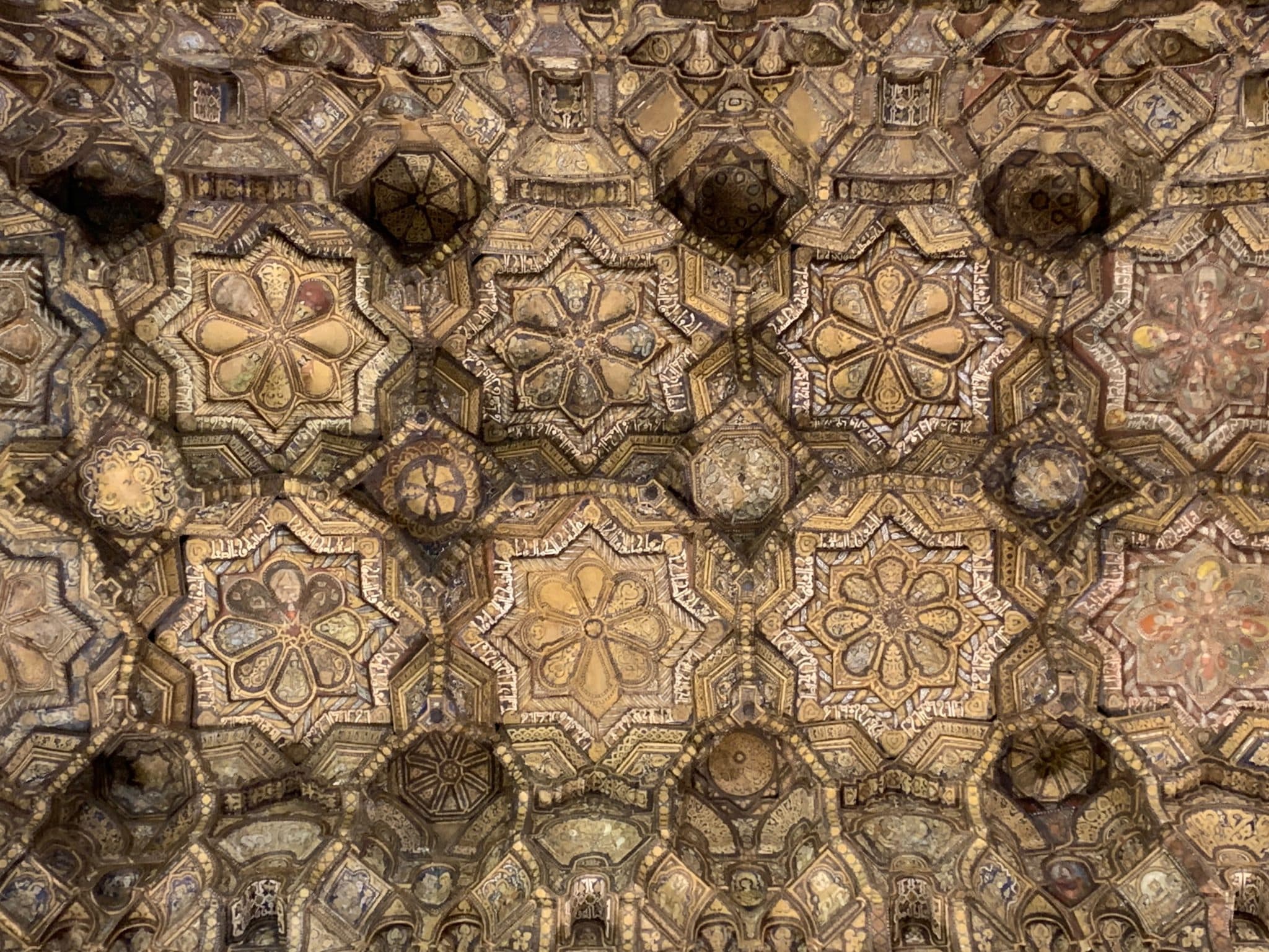
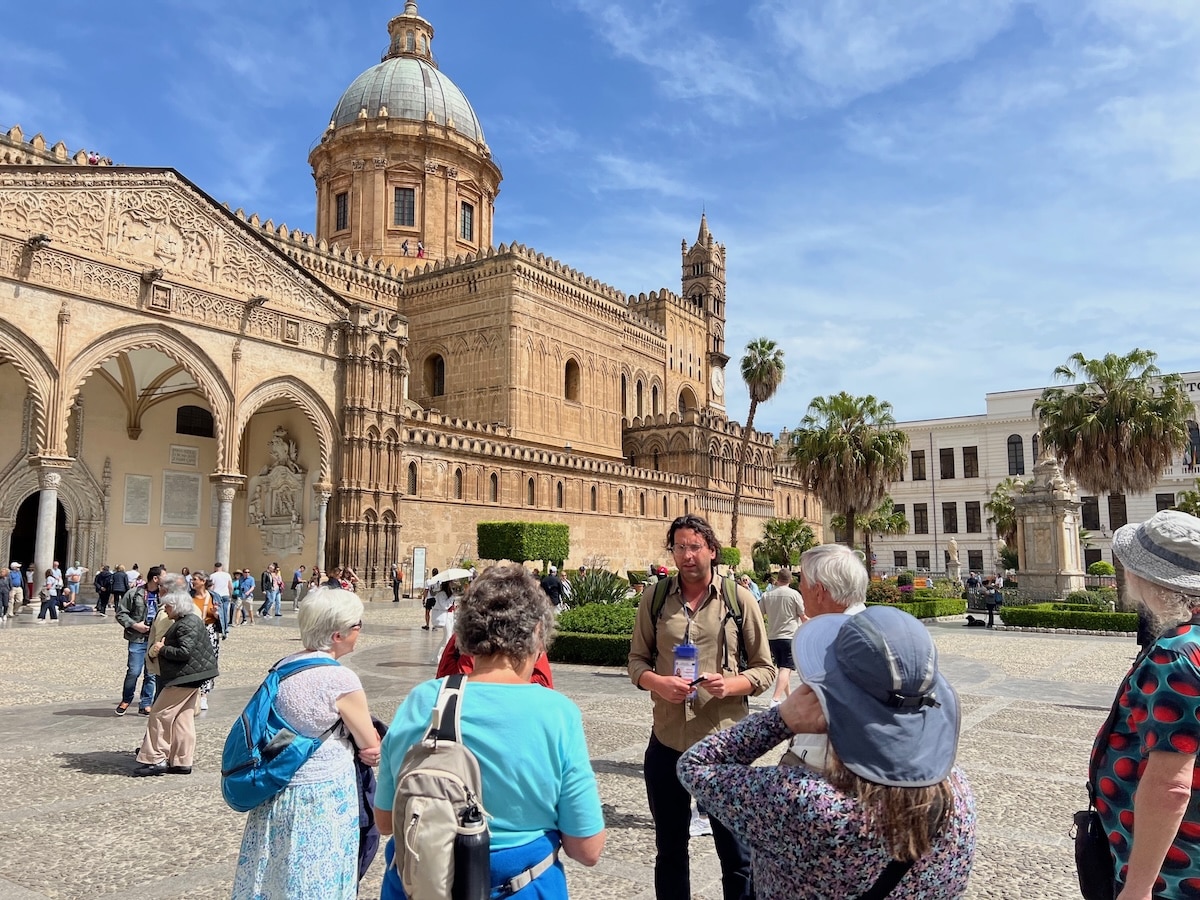
The chapel’s interior is covered in mosaics of extraordinary refinement, following the conventions of a Byzantine church: Christ Pantocrator, the archangels, the Annunciation and Nativity, portraits of the Greek church fathers. Its ceiling, added under William I around 1160, is a muqarnas structure of five wooden tiers in the Fatimid style, painted with scenes of daily life. Byzantine, Norman and Fatimid influences sit side by side in a single building, a fair reflection of Palermo’s society at the time, and the result is a wealth and an opulence unmatched anywhere else in Italy at that date. The present Cathedral, built later under William II on the site of the city’s great Friday mosque, tells a similar layered story.
Proof, in four languages
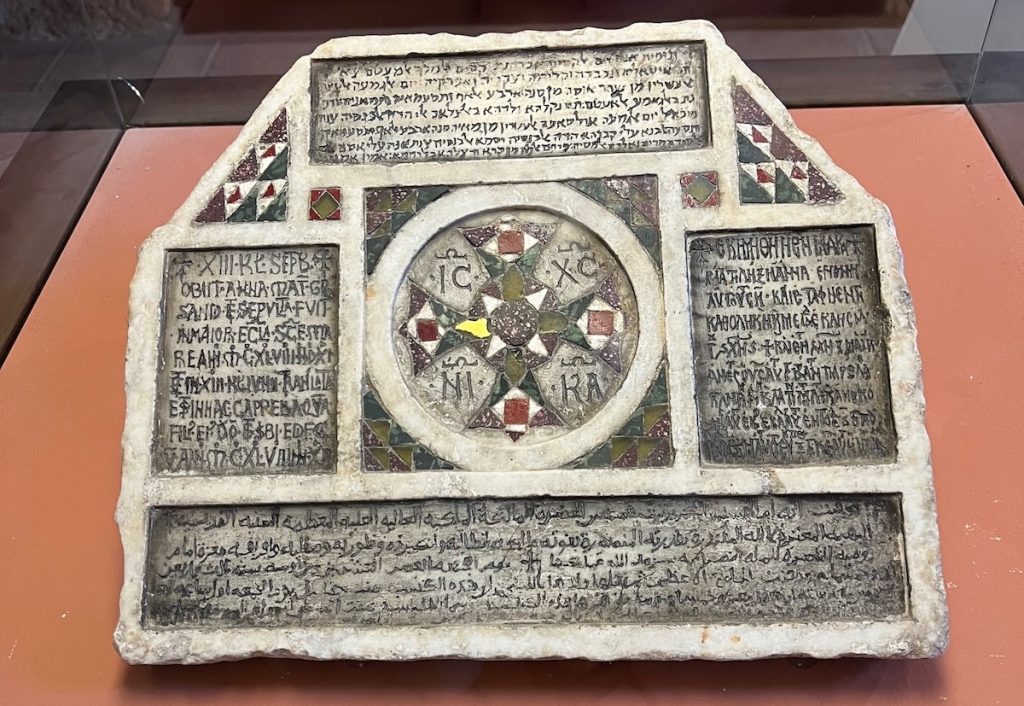
Perhaps the single most vivid piece of evidence for what twelfth-century Palermo actually looked like isn’t a building at all, but a small marble funerary plaque, now on display in the Palazzo della Zisa. It commemorates Anna, mother of the priest Grisantus, who died in 1148, and her epitaph is carved in four languages side by side: Latin, Greek, Arabic and Hebrew. It’s a striking, tangible confirmation of everything the historical record suggests about the city’s population in this period: Muslim, Christian and Jewish, Arabic, Greek and Latin speaking, all living, working and, in this case, mourning together in the same city.
By the middle of the twelfth century, this was a city that had become, by most measures, the envy of the Western world, wealthy enough and confident enough to draw the attention of the Holy Roman Emperor Frederick Barbarossa himself. How he set about acquiring it, if not for himself, then for his family, is where the story picks up next.
This is the first in our series on the history of Palermo, one of the stops on Esplora Travel’s Treasures of Sicily tour.
Latest posts & articles
When you travel with us, our aim is to give you the very best travel experience. We travel in small groups of like-minded people with expert local guides.