Why Are There Ancient Greek Theatres in Turkey?
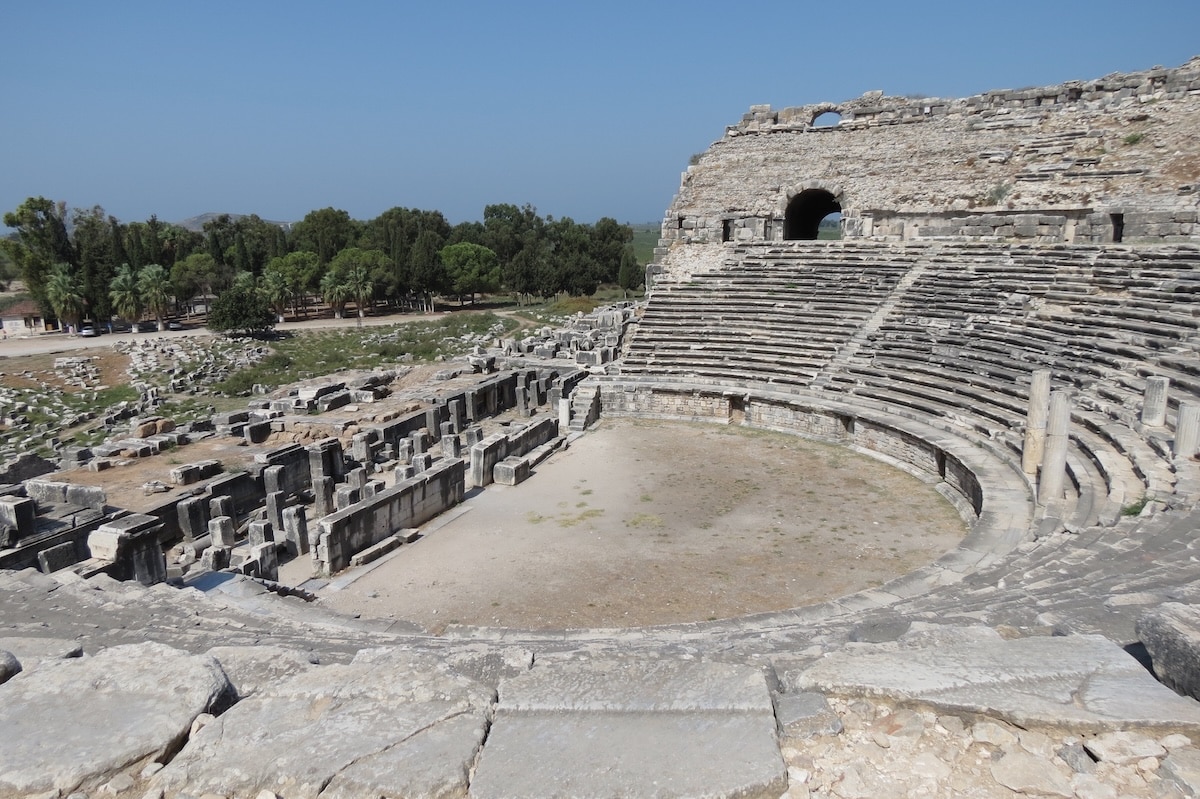
Travellers walk into the theatre at Ephesus, or climb the steep, cliffside theatre at Pergamon, and ask some version of the same question: why does this look so Greek? This is Turkey, not Greece. The answer is a story that unfolds region by region and century by century, across the coastline that once linked Pergamon, Sardis, Ephesus, Aphrodisias, Didyma, Miletus and Priene, so that the next time you stand among these ruins, the story behind the stone is already familiar.
A coast of separate regions
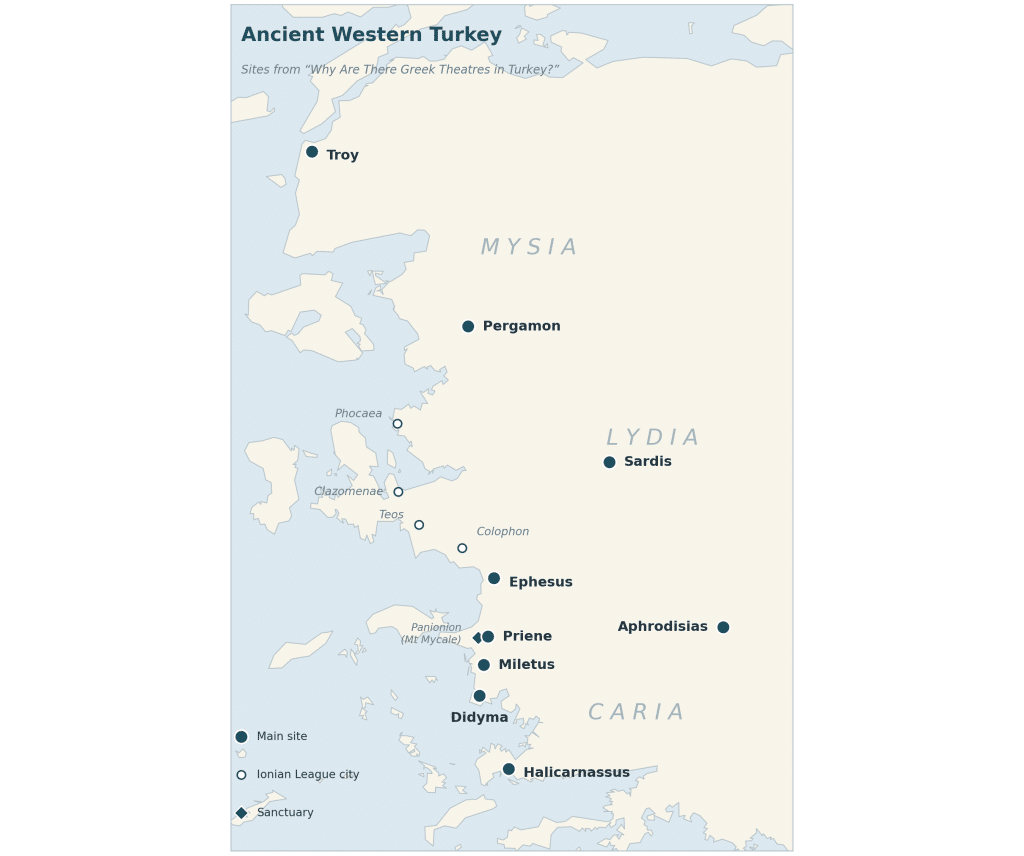
Before any history, it helps to picture this coast as a journey across a map rather than a single country. It was never one unified place in antiquity, but a string of distinct regions, each with its own name, its own native people and its own character.
At the northern end sits Mysia, and right at its tip, cut off from the rest of Anatolia by Mount Ida, is the small peninsula known as the Troad, home to Troy. Moving further into Mysia proper brings us to Pergamon. South of that lies Lydia, home to Sardis. And further south again is Caria, the region behind Miletus, Didyma, Priene and Aphrodisias. Together, Mysia, Lydia and Caria form a line running down the coast, and it’s worth holding that map in mind, because almost everything else in this story happens on top of it.
Before the Greeks arrived
None of this land was empty when the Greeks turned up. Long before any Greek settler set foot on this coast, western Anatolia was already home to a much older world. In the Bronze Age, roughly 1700 to 1200 BC, the great Hittite kingdom dominated central Anatolia from its capital at Hattusa, and the region around Ephesus may even have been Apasa, capital of a related Bronze Age kingdom called Arzawa.
Why did that older world collapse?
When that older world collapsed around 1200 BC, it went down fast, and the evidence for it is unusually vivid. Historians call it the Late Bronze Age Collapse: within a few decades, the Hittite capital Hattusa was abandoned, the Mycenaean palaces of Greece were destroyed, and the Syrian trading city of Ugarit was burned and never resettled, its archive of clay tablets baked hard by the very fire that ended it, including a letter describing enemy ships attacking while the city’s own fleet was away. Egyptian temple inscriptions blame an invasion by groups they called the Sea Peoples, though most historians now see that as one symptom among several, alongside a sustained drought, a cluster of major earthquakes, and the fragility of trade networks that a whole region had come to depend on for the tin and copper needed to make bronze in the first place.
A patchwork of smaller, native successor peoples emerged in the wake of that collapse: the Mysians in the northwest, the Lydians further south around Sardis, and the Carians further south still, around Miletus, Didyma and Priene. These are generally understood as descendants of that older indigenous Anatolian culture. So when Greek settlers began arriving from around 1000 BC onward, they weren’t colonising empty land. They were moving into territory that already belonged to someone else.
The Ionian migration
Starting around 1000 BC, waves of Greek settlers, mainly from Athens and the surrounding region, crossed the Aegean in what’s known as the Ionian migration. They founded a string of cities along the central Anatolian coast that became known collectively as Ionia, twelve of which formed the Ionian League, including Ephesus, Miletus and Priene.
The Ionian League, also called the Panionic League, is worth pausing on, because it’s the thread tying these twelve separate foundation stories into something more than a coincidence of geography. Herodotus records its traditional membership: on this coast, Miletus, Myus, Priene, Ephesus, Colophon, Lebedos, Teos, Erythrae, Clazomenae and Phocaea, plus two island cities just offshore, Chios and Samos, both in Greece today rather than Turkey. Tradition credits its formal organisation to the aftermath of the Meliac War, a conflict between Samos and Miletus over control of Priene that ended in the mid-7th century BC. The League was never a political union in any modern sense, each city kept its own government and fought its neighbours as often as not, but a religious and cultural federation, built around a shared sanctuary at the Panionion on Mount Mycale, near modern Guzelcamli, close to Kusadasi and Ephesus. Once a year, delegates from all twelve cities gathered there for a festival called the Panionia. That sense of shared Ionian identity, real even without political unity, is exactly what resurfaces two centuries later, when these same cities rise together against Persia in 499 BC.
Ephesus has the most evocative founding legend of the group. It was said to have been founded by Androklos, a prince of Athens forced abroad after the death of his father, King Kodros. According to the story, he consulted the oracle at Delphi, who told him, “a fish and a boar will show you the way,” and duly found his site on Ayasuluk Hill after exactly that happened. Androklos went on to unite the twelve Ionian cities into their league, before dying in battle defending Priene. A rival tradition credits the city’s founding instead to the Amazons, a legend that stuck to Ephesus for centuries.
Miletus tells a very different, older story. The site had genuine Bronze Age roots long before any Greek arrived, inhabited from the Neolithic period, in contact with Minoan Crete from around 2000 BC, and a Mycenaean stronghold from around 1450 to 1100 BC, with a native Carian population living there throughout. The Greek founding legend is a considerably darker one than Androklos’s: the arriving Ionians are said to have killed the Carian men and married their widows.
Priene, by contrast, appears to be a clean Greek foundation, a colony from Thebes around 1000 BC with no solid evidence of anyone living there earlier. And Didyma sits somewhere in between: its very name may be Carian rather than Greek, and some scholars suspect its sanctuary continued an older, native sacred site, though nothing can be proven earlier than the Greek period itself.
Croesus, Lydia and the coming of Persia
While the Greek cities were establishing themselves on the coast, an entirely different, non-Greek kingdom was rising inland: Lydia, with its capital at Sardis. The Lydians had built an independent kingdom from around 800 BC, and their most famous king, Croesus, who reigned from about 560 to 546 BC, became legendary for his wealth (hence the phrase “rich as Croesus”) and for extending Lydian influence over Caria and the Greek Ionian cities. The Lydians are also credited with inventing coinage: their earliest coins, struck from the 7th century BC, were electrum, a natural alloy of gold and silver panned straight from the Pactolus river near Sardis. Croesus went a step further, refining electrum into separate pure gold and pure silver coins, minted to a standardized purity, the world’s first true gold coinage.
Croesus’s reign ends in 546 BC, when Cyrus the Great’s Persian army defeats him and captures Sardis, absorbing the entire Lydian kingdom, and with it the Greek coastal cities, into the vast Achaemenid Persian Empire. Sardis becomes the seat of a Persian satrap and the western terminus of the Persian Royal Road, running all the way back to Persepolis. For close to two centuries, the Greek cities on this coast are technically Persian subjects.
That arrangement finally cracks in 499 BC, when the Ionian Revolt breaks out, the Greek coastal cities rising against Persian rule with Athenian help, briefly capturing and burning Sardis before being crushed by 494 BC. That revolt is what pulls the Persian kings Darius and then Xerxes into invading mainland Greece directly, leading to the battles every schoolchild has heard of: Marathon (490 BC), Thermopylae and Salamis (480 BC), and Plataea (479 BC), all of them ultimately Persian attempts to punish and pacify Greece for interfering in Persia’s own Anatolian territory.
It’s worth noting that Persia’s defeat at Salamis and Plataea did not end the Achaemenid Empire. It carried on for another century and a half, still holding Sardis and the whole Anatolian coast, formalised by a settlement between Athens and Persia in 449 BC. Nothing changes here again until Alexander the Great arrives.
Alexander’s conquest
Alexander’s own people, the Macedonians, occupied an ambiguous position in the Greek world. Southern Greeks, particularly Athenians, often viewed them with suspicion, even as semi-barbarian, yet the Macedonians considered themselves Greek, worshipped the same gods, and spoke a dialect closely related to Greek. Their prestige language at court was Attic Greek, the Athenian dialect, which later evolved into the common Koine Greek spread across Alexander’s conquests.
Alexander’s stated reason for invading Persia was revenge. His father, Philip II, had unified the Greek states under a body called the League of Corinth, built around a panhellenic mission to avenge the Persian invasions of Greece from a century and a half earlier. Philip was murdered before he could act on it, so twenty year old Alexander inherited both the throne and the pretext. Underneath the official justification lay something more personal: an intense restlessness ancient writers called pothos, a hunger for glory that pushed him, once Persia itself was conquered, to keep going, all the way to India, until his own soldiers finally refused to march any further.
The campaign in western Anatolia begins in 334 BC. Alexander crosses the Hellespont, pays homage at Troy before any fighting begins (he saw himself as a second Achilles), and wins his first major battle at the Granicus River nearby. With the local Persian force broken, Sardis surrenders without a fight, Ephesus opens its gates peacefully, and only the coastal strongholds further south, Miletus and Halicarnassus, need to be taken by siege. At Halicarnassus, in Caria, Alexander allies himself with the exiled Carian queen Ada, who formally adopts him as her son, a clever piece of political theatre that helps legitimise his rule over the region. Within a single campaigning season, this entire coast passes from Persian to Macedonian Greek control.
The Hellenistic age and the rise of Pergamon
The Hellenistic period runs from Alexander’s death in 323 BC to 30 BC, when the last of his successor kingdoms, Ptolemaic Egypt, fell to Rome. It describes the spread and blending of Greek culture across the vast territory Alexander had conquered, now ruled by a patchwork of Greek and Macedonian successor kings rather than one empire.
Pergamon’s rise during this period is one of the better stories in the whole region. It begins with Philetaerus, a Greek-Paphlagonian officer entrusted with Pergamon’s fortress and its enormous treasury of nine thousand talents of silver by one of Alexander’s successors, Lysimachus. When Lysimachus turned on his allies, Philetaerus switched sides, handing the fortress and treasure to a rival, Seleucus. Both Lysimachus and, soon after, Seleucus were dead within the year, and Philetaerus found himself in effective control of an independent city and a fortune with nobody left to answer to. He spent the next forty years using that wealth to build Pergamon’s reputation, and adopted his nephew Eumenes I as his heir, founding the Attalid dynasty.
The dynasty’s defining moment comes with Attalus I, who around 238 to 235 BC defeated the Galatians, Celtic invaders who had long extorted tribute from the cities of Asia Minor. Attalus was the first ruler to refuse to pay them and beat them outright. He declared himself king, took the title Soter, “Saviour,” and commissioned a wave of triumphant sculpture, including the famous Dying Gaul, casting Pergamon as the defender of Greek civilisation against the barbarians. That self-image shapes the city’s most dramatic monument, the Great Altar, with its sculpted battle between gods and giants. German archaeologists excavated the altar’s sculpted frieze in the 1870s and 1880s and took it to Berlin, where it’s reconstructed and on display in the Pergamon Museum today, so a visitor to Pergamon itself sees the altar’s foundations on the acropolis rather than the frieze that made it famous. Under Eumenes II and Attalus II, following the Treaty of Apamea in 188 BC, Pergamon reaches its territorial and cultural peak: a vast new city wall, a renowned library, and an acropolis deliberately remodelled after the Acropolis in Athens.
Rome inherits a Greek world
Rome’s arrival in this story is less a conquest than a slow inheritance. Rome first became militarily involved in the region in 190 BC, fighting the Seleucid king Antiochus III at the Battle of Magnesia, with Pergamon’s King Eumenes II fighting alongside them (Hannibal, exiled from Carthage, was present on the losing side). The resulting Treaty of Apamea in 188 BC stripped Antiochus of his territory in Asia Minor and handed most of it not to Rome, but to its ally Pergamon.
Rome only takes direct control decades later, and even then not by force. In 133 BC, the last Attalid king, Attalus III, dies without an heir and simply wills his entire kingdom to Rome. After putting down a rebellion against the handover, Rome formally organises the territory as the province of Asia by 129 BC. There are darker chapters still to come, notably the massacre of tens of thousands of Romans and Italians across the province in 88 BC, ordered by King Mithridates VI of Pontus, and Sulla’s reorganisation of the province in its aftermath, but by the time of Augustus, the region has settled into the stable, prosperous Roman provincial system whose buildings still stand today.
What matters most here is what didn’t change. Rome did not replace Greek culture in the East, it absorbed it. Greek remained the everyday language of the entire eastern Mediterranean, the language of administration, education and daily life, while Latin stayed dominant in the west. Educated Romans learned Greek as a matter of course. Centuries later, the emperor Marcus Aurelius wrote his private philosophical journal, the Meditations, in Greek rather than Latin. As the Roman poet Horace put it, captive Greece took her savage conqueror captive. Politically, this coast becomes Roman. Culturally, it stays Greek.
Christianity takes root
Christianity arrives comparatively early here, and in layers. Paul spent close to three years in Ephesus in the 50s AD, his longest stay anywhere, working as a tentmaker while he preached. His success converting people away from the cult of Artemis provoked a riot among the city’s silversmiths, whose livelihood depended on selling silver shrines of the goddess. He also passed through Miletus, where he gave an emotional farewell speech to the elders of the Ephesian church.
John the Apostle arrives in the story later, according to tradition settling in Ephesus and dying there of natural causes sometime after AD 98, during Trajan’s reign, the only apostle said not to have been martyred. His tomb was venerated at what became the Basilica of St John. It’s worth noting, too, that the Book of Revelation is addressed to the “Seven Churches of Asia,” three of which, Ephesus, Pergamon and Sardis, are among the cities in this story.
None of this makes Christianity legal. For more than two further centuries it remains a persecuted, often underground faith within a pagan Roman Empire. That changes with Constantine the Great, whose Edict of Milan in 313 AD legalises Christianity, alongside every other religion, without yet making it the state religion. Just twelve years later, in 325 AD, Constantine convenes the First Council of Nicaea, at what is now Iznik, to settle a serious doctrinal dispute and produce the Nicene Creed still recited in churches today. Christianity only becomes the Roman Empire’s official state religion later still, under Theodosius I, in 380 AD. Nicaea hosts a second great council in 787 AD, on the use of religious images, giving the town two ecumenical councils to its name, centuries before it became known, under the Ottomans, for something entirely unrelated: its painted ceramic tiles.
A Greek world, in Roman dress
These cities were Greek long before they were ever Roman. Ionian settlers founded them on land that already belonged to native Anatolian peoples, the Carians, Lydians and Mysians, sometime after 1000 BC. Lydian and then Persian rule followed, until Alexander the Great swept through in 334 BC and opened two centuries of Hellenistic Greek flourishing, the age that gave Pergamon, Priene and Didyma their defining monuments. Rome inherited this world rather than conquering it outright, and rather than erasing its culture, simply funded grander versions of it, on top of cities that never stopped speaking, thinking, or building as Greeks. Christianity arrived early and quietly, on top of all of it, before finally being formalised by the same empire two and a half centuries later.
So the “Greek theatre” that prompts the question isn’t a contradiction at all. It’s a Greek city, under Roman government, still Greek at heart, standing in what is now Turkey.
Troy, the one place in this story that reaches back further than any other, is where it properly begins, and it’s one of the sites on Esplora Travel’s Treasures of Western Turkey tour, alongside Pergamon, Sardis, Ephesus and Aphrodisias, tracing this same coastline from the Bronze Age to Byzantium.
Latest posts & articles
When you travel with us, our aim is to give you the very best travel experience. We travel in small groups of like-minded people with expert local guides.