
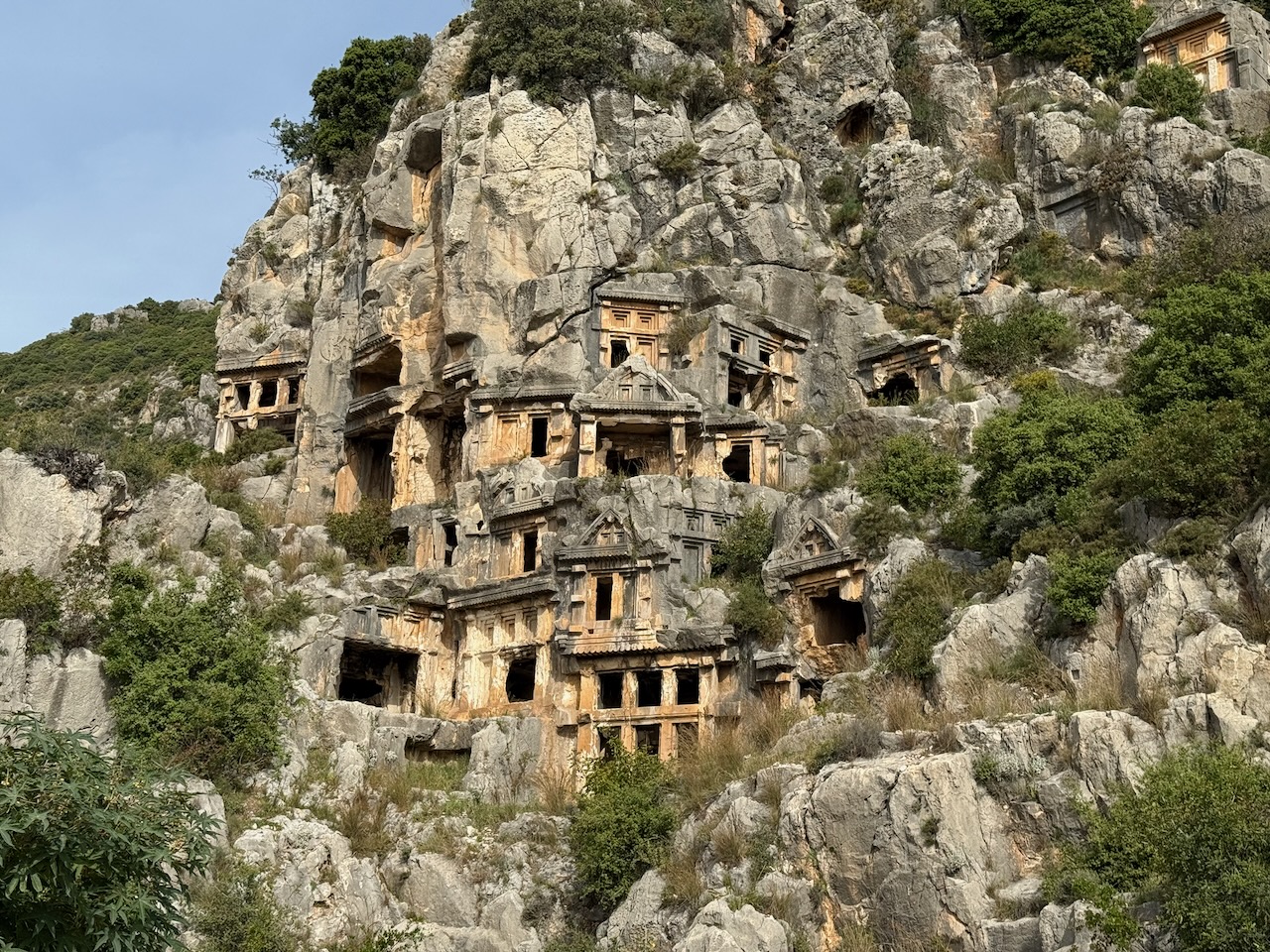
Annabelle Thorpe writes her travelogue of our April 2026 Lycian Coast tour:
Day six of my first ever Esplora Travel tour along the beautiful, history-rich coast of Lycian Türkiye, and I didn’t think there was anything that could impress me more than what I had already seen. I’d stood at the top of the spectacular amphitheatre at Tlos and gazed out to the distant, snow-capped peaks of the Taurus mountains, peered up at breathtaking Lycian rock tombs, carved into the hillside above the Dalyan river, and walked the vertiginous ruins at Arycanda, where thousands of years of history could actually be felt. It had already been a week of extraordinary experiences. And then we arrived at Termessos.
‘It’s just a short, twenty-minute walk up from here,’ said Cankat, our guide, when we clambered out of the minivan, already high up in the mountains. It turned out he had a gift for understatement; the path wound upwards for what seemed like forever, occasionally fragmenting into crops of rock that needed careful navigation. ‘Took us an hour and a half,’ muttered a disgruntled Turkish Dad, as he stumbled wearily back down behind two over-excited small boys (thankfully, Cankat didn’t translate that until we were safely at the top).
It was a long haul but, once we found ourselves at the amphitheatre, the memory of the climb fell away. Termessos amphitheatre stands 1,000 metres high, perched on the top of Güllük Dağı (mountain), overlooked by another towering peak. It is astonishing; for its views, for its location, for the sheer audacity of deciding to build a city high on a mountain, at a time when mechanisation and cranes and diggers were centuries away.
Termessos was just one of many surprises revealed to me, as we travelled through a region of Türkiye I genuinely thought I knew like the back of my hand. I first visited Kalkan – one of the stops on our trip – in 1994, and have been back to the region almost every year. The itinerary – Akyaka, Dalyan, Fethiye, Ölü Deniz, Patara, Kalkan – read like a greatest hits album from my past, the perfect introduction to my new role as tour manager with Esplora – an easing in on wonderfully familiar territory. Little did I know that I was going to see the region in a whole new light.
We met first – Cankat our guide, Mehmet our guide, Damian (official tour manager) and our guests – at Bodrum airport, where it quickly became clear that the pace of an Esplora tour is far more relaxed than other escorted group tours I’ve experienced. Our first lunch, in the small river town of Akyaka, was a feast of fresh salads, before a gentle stroll into town and a tranquil boat trip, past tree-lined banks dotted with picnicking families and Turkish couples sat in camping chairs, luxuriating in a sunny Saturday afternoon. There was a pleasant sense of pottering, that our trip was going to run to the relaxed rhythm of Turkish life.
The following day, our exploration began in earnest, with a visit to the first of nine ancient sites we would see on our trip. If that sounds a lot, it’s worth pointing out that all – without exception – were blissfully quiet; entirely free of the cruise crowds and gaggles of tour groups that flood into Ephesus. For me, this is what makes visiting an ancient site truly memorable; the chance to experience it free of 21st century disturbances, allowing the centuries to roll back, to imagine the streets and baths flowing with life, the thousands of seats in the amphitheatres filled with spectators.
Our first visit was to the Carian port city of Kaunos; a site I’d never been to before. Located just across the Calbis (as it was known then) river from Dalyan, it was also close to the border with Lycia; a neighbouring Anatolian group. Caria reached its peak of power in the mid 3rd century BCE, while Lycia reigned supreme from the 2nd century BCE to the 2nd century AD, when it was the first known democrative federation in history. The rich legacy of both societies has left a wealth of ancient sites scattered across southern Türkiye; a region better known, to British visitors at least, for its beach resorts and glittering coastline than its rich history.
As the days unfolded, I began to gain a whole different perspective on the landscapes I thought I knew so well. Instead of thinking of Patara as my favourite beach, Xanthos as a small ancient site I’d once visited and Tlos as some rock tombs up in the hills, I began to stitch them together as three linked cities. Xanthos was the capital, Patara the busy port and Tlos a hilltop city, where the great and good were buried in the rock tombs that remain today. Standing by the walls of the Roman bath complex, I could see the shimmering waters of Patara far off in the distance, and easily imagine the transportation of goods, soldiers – and people – between the two.
Exploring the sites was taken at a leisurely pace, with plenty of time to stop and soak up the atmosphere, and listen to tales and anecdotes from our guide. Cankat got the balance just right, providing us with insights rather than long monologues, understanding that sometimes the best way to really understand these places is to walk without conversation, to almost sink into the silence. The pace, for me, was perfect; no tap of the watch, or instruction to be back at the minivan at a certain time.
And in-between the history and the ancient sites, how well we ate! Simple cafes for lunch – often sourced by our charming driver, Mehmet, while we were off exploring – that gave us succulent kebabs, pillow-soft bread, rich bean casseroles, thick with herbs and mild spices. Every meal felt like somewhere locals would eat, with traditional tulip-shaped glasses of cay bought by smiling owners, each time we finished a meal.
Eating communally proved a great way to get to know everyone in the group; a chance to relax and share stories from previous trips or visits to Türkiye. In the evenings, we ate meze on Kalkan’s chic harbour and classic Anatolian dishes in the back streets of Antalya, at family-owned restaurants where local olive oil, fresh herbs and that tang of pul biber – Turkish chill flakes – infused every mouthful.
My favourite evenings were our two suppers in Fethiye’s bustling fish market, where our butter-soft sea bream was chosen straight from the fish counter, preceded by delicious meze, picked from thirty or so dishes lined up behind a glass counter. All around us, Turkish friends and families were drinking raki (the local aniseed spirit) and tucking into plates of crispy calamari, rose-skinned prawns and bowls of çoban salata (mixed salad). It felt as if we, too, were locals rather than visitors, met up for an informal evening supper as the sun drifted off behind the gleaming gulets in Fethiye harbour.
And afterwards, we had pleasingly characterful hotels to return to, from a luxurious spa hotel in Akyaka, where the serpme kahvalti (traditional breakfast) would have taken all day to finish; local cheeses, fresh tomatoes, cucumber and herbs, hand-made breads, eggs and sixteen small bowls filled with hand-made jams, relishes, butters and honey, perfect for dipping into with a corner of crisp, pide bread. In Antalya, a clutch of old Ottoman houses had been lovingly converted into an elegant boutique hotel, with two terraces, one with bar and restaurant tables shaded by citrus trees, the other with a small pool, perfect for a post-sightseeing dip.
Not every moment of our trip was spent together. I valued the free afternoons in Kalkan and Antalya; time to wander, to sit with a cold Efes (local beer) and watch the world go by. In Antalya, I got pleasurably lost in the tangle of alleyways in the Kaleiçi (the Old Town) and somehow surfaced back almost where I had began. But what I valued most was the relaxed feel of the trip; the feeling of travelling with knowledgeable friends, rather than a formal guide and manager. Instead, we quickly became just one group; Cankat, Mehmet, Damian and us – a happy clan meandering our way across the spectacular Turkish countryside.
As someone who’s been visiting the region for thirty years, what amazed me most was to see the changes that have taken place at some of the ancient sites; the incredible progress that has been made in uncovering the historical remains. Nowhere was this more apparent than at Patara which, when I first drove through it in 1994 (heading straight from the beach), was little more than a sandy wasteland, pockmarked with occasional shards of column and rock. Now, a gleaming museum awaited us alongside an impressive amphitheatre, that gave a real sense of how vast the city would once have been.
Change is inevitable in the time I have been visiting Türkiye, but what I loved most about this trip was that it reconnected me with the country I first fell in love with, way back in the 1990s. To visit in April, when the fields are a sea of wildflowers, the scenery is lush and green, but there is barely another tourist about – proved to be the perfect time, a chance to experience Türkiye before the season really begins, to gain an insight into how it is to live there for those who permanently call it home. I hadn’t thought it possible to explore this – the most touristic region of Türkiye – without encountering some of the excesses of modern development, but this wonderful trip caused me to think again.
This, for me, was the real beauty of this tour; it showed me that authentic and tourist Türkiye can – and do – co-exist alongside each other, if you know where to look. It’s down to Damian’s thorough research and curation – someone who loves Türkiye as I do – that this tour offers up both its glittering past and authentic present – the perfect combination for an unforgettable trip.
Annabelle Thorpe, April 2026
The eight-night Lycian Türkiye tour costs £3,450pp and will run 10th-18th April 2027. Annabelle Thorpe will be its (very enthusiastic) tour manager.


